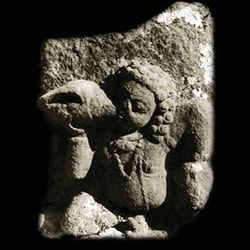
| Narayan,
or Vishnu, is the preserver of creation of Hinduism. His temple
near Changu Village, or Doladri in Sanskrit, is often described
as the most ancient temple in the Kathmandu Valley. A legend
says that once Vishnu in his act of destroying evil killed a
Brahmin priest who had turned to evil. Such an act was considered
one of the five most heinous crimes. Vishnu contemplated his
deed and wandered here and there on Garuda, the mythical half
man, half bird form. When he reached Changu, a hermit by the
name of Sudarsana, not recognizing Lord Vishnu, beheaded him.
Once beheaded, Vishnu felt regretful of his sin. He said that
from then onwards he will live on the hill at Changu, where
he was redeemed for his sin, and that everyone who comes to
worship him at Changu on the day of the full moon or on Wednesdays
will also be exonerated. The nitya puja, ritual worshipping,
at Changu Narayan relates to this legend. The Vishnu image here
is built of two parts, one of the head and the other of the
body so that the beheading rite of Vishnu can be remembered
during the puja.
Despite
the legendary origin of the temple, Changu Narayan is believed
to be built by Haridatta Varma, who was a Licchavi king who
ruled around 325 AD several generations before Manadev I.
Chronicles say that at that time Haridutta had ordered the
building of four hilltop Narayan temples around the Valley.
The other temples are Ichangu Narayan, at the West, Sikhara
Narayan, and Lokapalasvamin. The inscription on Garuda Dhwaja,
a pillar that tells of the victorious Manadev I, erected at
the temple in 464 is the oldest inscription to have been discovered
in Nepal. The inscription on the pillar is the first solid
evidence to prove the establishment of the temple, though
it indicates that the temple stood before that time. As it
was the costume of the royal families to offer gifts to the
temple, Changu Narayan also drew many regal worshippers. However,
most of the gifts were in the form of reconstructions of the
temple, which was destroyed many times by fires and earthquakes.
In 607, King Amsuvarma, who highly regarded Changu Narayan,
replaced the old sheath that covered the holy image and gave
a large sum of money to the temple. The temple began to crumble
into pieces due neglect and was left unrestored until Visva
Malla (1548-1560) of Bhaktapur took up the task. Then Gangarani
of Kathmandu, grandmother of Pratap Malla, repaired the temple
when it was devastated by a fire. In 1694, the temple again
needed reconstruction which was offered by Queen Mother Radhiklaksmi
of Kathmandu. She also offered other richly gifts like a golden
torana for the temple, an amount of gold and silver equal
to her own weight, as well as a statue of herself and her
son kneeling in front of the temple behind the Garuda Dhwaja
of Manadev I. About that time the head of the image of Vishnu
was offered by Bhupalendra Malla of Kathmandu when the previous
one broke during a puja. Twenty years after the construction
by the Queen Mother Radhiklaksmi, the temple again caught
fire. This time it was Bhaskar Malla (1700-1722) of Kathmandu
who rebuilt the temple and marked its completion by refinishing
the roof of the temple.
In
Buddhism, Changu Narayan is revered as Boddhisattva Avalokiteswara.
They believe that Garuda, the mount of Lord Vishnu, and Takshaka,
the king of serpents of the Kathmandu Valley, were engaged
in a ferocious battle. When Garuda called upon Lord Vishnu
for help, Takshaka was certain of his peril and prayed for
Boddhisattva Avalokiteswara. The compassionate Avalokiteswara
stopped the battle and brought peace to the adversaries. Vishnu,
ashamed of his behavior in the battle offered to be Boddhisattva
Avalokiteswara's steed and carried him to Changu and thus
created the peculiar icon of Hari hari hari Vahan Lokeswora.
At Changu Narayan, Boddhisattva Avalokiteswara is shown separately
as a stone sculpture behind the temple while Garudasana Narayan,
Vishnu on Garuda, is been the revered image of the temple.
There are two other copies of the Garudasana Narayan image
in the temple courtyard. One was made in tenth century and
other in thirteenth century, which were eventually copied
in many Narayan images found around Kathmandu.
The
temple now covers at least seventeen hundred years of Nepalese
art history. The temple, built around the third century, is
decorated by some of the best samples of stone, wood, and
metal craft in the Valley. In the words of one tourist guide,
"When you look upon Changu Narayan, you observe the complete
cultural development of the Valley."
On
the struts of the two-tiered Changu Narayan Temple are the
ten incarnations in which Narayan destroyed evildoers. A sixth
century stone statue shows the cosmic form of Vishnu, while
another statue recalls his incarnation as a dwarf when he
crushed King Bali. A statue of Vishnu disemboweling Narsingha,
a man-lion, is particularly interesting. The Eastern doors
are made of bronze, dragons decorate the bells, and devas
and griffins look out from the walls and steps. A life-sized
statue of Garuda kneels before the temple. The favorite sight
of many visitors is the statue of Vishnu sitting astride his
steed.
|