|
The
Kathmandu Durbar Square holds the palaces of the Malla and
Shah kings who ruled over the city. Along with these palaces,
the square also surrounds quadrangles revealing courtyards
and temples. The square is presently known as Hanuman Dhoka,
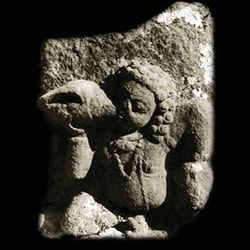
a name derived from the statue of Hanuman, the monkey devotee
of Lord Ram, near the entrance of the palace. The preference
for the construction of royal palaces at this site dates back
to as early as the Licchavi period in the third century. Even
though the present palaces and temples have undergone repeated
and extensive renovations and nothing physical remains from
that period, names like Gunapo and Gupo, which are the names
referred to the palaces in the square in early scriptures,
imply that the palaces were built by Gunakamadev, a king ruling
late in the tenth century. When Kathmandu City became independent
under the rule of King Ratna Malla (1484-1520) the palaces
in the square became the royal palaces for its Malla kings.
When Prithvi Narayan Shah invaded the Kathmandu Valley in
1769, he also favored the Kathmandu Durbar Square for his
palace. Other subsequent Shah kings continued to rule from
the square until 1896 when they moved to the Narayan Hiti
Palace. However, the square is still the center of important
royal events like the coronation of King Birendra Bir Bikram
Shah in 1975 and King Gyanendra Bir Bikram Shah in 2001.
Though
there are not any written archives stating the history of
the Kathmandu Durbar Square, the construction of the palace
in the square is credited to Sankharadev (1069-1083). As the
first king of the independent Kathmandu City, Ratna Malla
is said to have built a Taleju temple at the Northern side
of the palace in 1501. For this to be true then the temple
would have had to have been built in the vihara style as part
of the palace premise surrounding the Mul Chok courtyard for
no evidence of a separate structure that would match this
temple can be found within the square.
The
construction of the Karnel Chok is also not clearly stated
in any historical inscriptions although it is probably the
oldest among all the courtyards in the square. A Bhagavati
Temple, originally known as a Narayan Temple, rises above
the mansions surrounding it and was added during the time
of Jagajaya Malla in the early eighteenth century. The Narayan
idol within the temple was stolen so Prithvi Narayan Shah
replaced it with an image of Bhagavati, completely transforming
the name of the temple.
The
oldest temples in the square are those built by Mahendra Malla
(1560-1574). They are the temples of Jagannath, Kotilingeswara
Mahadev, Mahendreswara, and the Taleju Temple. This three-roofed
Taleju Temple was established in 1564, in a typical Newari
architectural style and is elevated on platforms that form
a pyramid-like structure. It is said that Mahendra Malla,
when he was residing in Bhaktapur, was highly devoted to the
Taleju Temple there; the Goddess being pleased with his devotion
gave him a vision asking him to build a temple for her in
the Kathmandu Durbar Square. Then with a help of a hermit,
he designed the temple to give it its present form and the
Goddess entered the temple in the form of a bee.
His
successors Sadasiva (1575-1581), his son, Shiva Simha (1578-1619),
and his grandson, Laksminar Simha (1619-1641), do not seem
to have made any major additions to the square. During this
period of three generations the only constructions to have
occurred were the establishment of Degutale Temple dedicated
to Goddess Mother Taleju by Shiva Simha and some enhancement
in the royal palace by Laksminar Simha.
It
was in the time of Pratap Malla, son of Laksminar Simha, that
the square was extensively developed. He was an intellectual,
a pious devotee, and he was especially interested in arts.
He called himself a Kavindra, king of poets, and boasted that
he was learned in fifteen different languages. A passionate
builder, following his coronation as a king, he immediately
began enlargements to his royal palace, and rebuilt some old
temples and constructed new temples, shrines and stupas around
his kingdom.
During
the construction of his palace, he added a small entrance
in the traditional, low and narrow Newari style. The door
was elaborately decorated with carvings and paintings of deities
and auspicious sings and was later transferred to the entrance
of Mohan Chok. In front of the entrance he placed the statue
of Hanuman thinking that Hanuman would strengthen his army
and protect his home. The entrance leads to Nasal Chok, the
courtyard where most royal events such as coronation, performances,
and yagyas, holy fire rituals, take place. It was named after
Nasadya, the God of Dance, and during the time of Pratap Malla
the sacred mask dance dramas performed in Nasal Chok were
widely famed. In one of these dramas, it is said that Pratap
Malla himself played the role of Lord Vishnu and that the
spirit of the Lord remained in the king's body even after
the play. After consulting his Tantric leaders, he ordered
a stone image of Lord Vishnu in his incarnation as Nara Simha,
the half lion and half human form, and then transferred the
spirit into the stone. This fine image of Nara Simha made
in 1673 still stands in the Nasal Chok. In 1650, he commissioned
for the construction of Mohan Chok in the palace. This chok
remained the royal residential courtyard for many years and
is believed to store a great amount of treasure under its
surface. Pratap Malla also built Sundari Chok about this time.
He placed a slab engraved with lines in fifteen languages
and proclaimed that he who can understand the inscription
would produce the flow of milk instead of water from Tutedhara,
a fountain set in the outer walls of Mohan Chok. However elaborate
his constructions may have been, they were not simply intended
to emphasize his luxuries but also his and the importance
of others' devotion towards deities. He made extensive donations
to temples and had the older ones renovated. Next to the palace,
he built a Krishna temple, the Vamsagopala, in an octagonal
shape in 1649. He dedicated this temple to his two Indian
wives, Rupamati and Rajamati, as both had died during the
year it was built. In Mohan Chok, he erected a three roofed
Agamachem temple and a unique temple with five superimposing
roofs. After completely restoring the Mul Chok, he also donated
to the adjoining Taleju Temple. To the main temple of Taleju,
he donated metal doors in 1670. He rebuilt the Degutale Temple
built by his grandfather, Siva Simha, and the Taleju Temple
in the palace square. As a substitute to the Indreswara Mahadeva
Temple in the distant village of Panauti he built a Shiva
temple, Indrapura, near his palace in the square. He carved
hymns on the walls of the Jagannath Temple as prayers to Taleju
in the form of Kali.
At
the Southern end of the square, near the Kasthamandapa, which
was the main city crossroads for early traders, he built another
pavilion named Kavindrapura, the mansion of the king of poets.
In this mansion he set an idol of dancing Shiva, Nasadyo,
which today is highly worshipped by dancers in the Valley.
In
the process of beautifying his palace, he added fountains,
ponds, and baths. In Sundari Chok, he established a low bath
with a golden fountain. He also built a small pond, the Naga
Pokhari, in the palace adorned with Nagakastha, a wooden serpent,
which is said he had ordered stolen from the royal pond in
the Bhaktapur Durbar Square. He also restored the Licchavi
stone sculptures such as the Jalasayana Narayana, the Kaliyadamana,
and the Kala Bhairav. An idol of Jalasayana Narayana was placed
in a newly created pond in the Bhandarkhal garden in the Eastern
wing of the palace. As a substitute to the idol of Jalasayana
Narayana in Buddhanilkantha, he channeled water from Buddhanilkantha
to the pond in Bhandarkhal due bestow authenticity. The Kalyadana,
a manifestation of Lord Krishna destroying Kaliya, a water
serpent, is placed in Kalindi Chok, which is adjacent to the
Mohan Chok. The approximately ten feet high image of terrifyingly
portrayed Kal Bhairav is placed near the Jagannath Temple.
This image is the focus of worship in the chok especially
during Durga Puja.
With
the death of Pratap Malla in 1674, the overall emphasis on
the importance of the square also came to a halt. His successors
retained relatively insignificant power and the prevailing
ministers took control of most of the royal rule. The ministers
encountered little influence under these kings and, increasingly,
interest of the arts and additions to the square was lost
on them. They focused less on culture than Pratap Malla during
the three decades that followed his death, steering the city
and country more towards the arenas of politics and power,
with only a few minor constructions made in the square. These
projects included Parthivendra Malla building a temple referred
to as Trailokya Mohan or Dasavatara, dedicated to Lord Vishnu
in 1679. A large statue of Garuda, the mount of Lord Vishnu,
was added in front of it a decade later. Parthivendra Malla
also added a pillar with image of his family in front of the
Taleju Temple.
Around
1692, Radhilasmi, the widowed queen of Pratap Malla, erected
the tall temples of Shiva known as Maju Deval near the Garuda
image in the square. This temple stands on nine stepped platforms
and is one of the tallest buildings in the square. Then her
son, Bhupalendra Malla, took the throne and banished the widowed
queen to the hills. His death came early at the age of twenty
one and his widowed queen, Bhuvanalaksmi, built a temple in
the square known as Kageswara Mahadev. The temple was built
in the Newari style and acted as a substitute for worship
of a distant temple in the hills. After the earthquake in
1934, the temple was restored with a dome roof, which was
alien to the Newari architecture.
Jayaprakash
Malla, the last Malla king to rule Kathmandu, built a temple
for Kumari, Durga in her virginal state. The temple was named
Kumari Bahal and was structured like a typical Newari vihara.
In his house resides the Kumari, an immature girl who is revered
as the living goddess. He also made a chariot for Kumari and
in the courtyard had detailed terra cotta tiles of that time
laid down.
During
the Shah dynasty that followed, the Kathmandu Durbar Square
saw a number of changes. Two of the most unique temples in
the square were built during this time. One is the Nautale,
a nine storied building known as Vasantapur Durbar. It has
four roofs and stands at the end of Nasal Chok at the East
side of the palace. It is said that this building was set
as a pleasure house. The lower three stories were made in
the Newari farmhouse style. The upper floors have Newari style
windows, sanjhya and tikijhya, and some of them are slightly
projected from the wall. The other temple is annexed to the
Vasantapur Durbar and has four-stories. This building was
initially known as Vilasamandira, or Lohom Chok, but is now
commonly known as Basantapur or Tejarat Chok. The lower floors
of the Basantapur Chok display extensive woodcarvings and
the roofs are made in popular the Mughal style. Archives state
that Prthivi Narayan Shah built these two buildings in 1770.
Rana
Bahadur Shah was enthroned at the age of two. Bahadur Shah,
the second son of Prithivi Narayan Shah, ruled as a regent
for his young nephew Rana Bahadur Shah for a close to a decade
from 1785 to 1794 and built a temple of Shiva Parvati in the
square. This one roofed temple is designed in the Newari style
and is remarkably similar to previous temples built by the
Mallas. It is rectangular in shape, and enshrines the Navadurga,
a group of goddesses, on the ground floor. It has a wooden
image of Shiva and Parvati at the window of the upper floor,
looking out at the passersby in the square. Another significant
donation made during the time of Rana Bahadur Shah is the
metal-plated head of Swet Bhairav near the Degutale Temple.
It was donated during the festival of Indra Jatra in 1795,
and continues to play a major role during the festival every
year. This approximately twelve feet high face of Bhairav
is concealed behind a latticed wooden screen for the rest
of the year. The following this donation Rana Bahadur donated
a huge bronze bell as an offering to the Goddess Taleju. Together
with the beating of the huge drums donated by his son Girvan
Yudha, the bell was rung every day during the daily ritual
worship to the goddess. Later these instruments were also
used as an alarm system. However, after the death of his beloved
third wife Kanimati Devi due to smallpox, Rana Bahadur Shah
turned mad with grief and had many images of gods and goddesses
smashed including the Taleju statue and bell, and Sitala,
the goddess of smallpox.
In
1908, a palace, Gaddi Durbar, was built using European architectural
designs. The Rana Prime Ministers who had taken over the power
but not the throne of the country from the Shahs Kings from
1846 to 1951 were highly influenced by European styles. The
Gaddi Durbar is covered in white plaster, has Greek columns
and adjoins a large audience hall, all foreign features to
Nepali architecture. The balconies of this durbar were reserved
for the royal family during festivals to view the square below.
Time
and again the temples and the palaces in the square have gone
through reconstruction after being damaged by natural causes
or neglect. Presently there are less than ten quadrangles
in the square. The temples are being preserved as national
heritage sites and the palace is being used as a museum. Only
a few parts of the palace are open for visitors and the Taleju
Temples are only open for people of Hindu and Buddhist faith.
Some
of the parts of the square like the Hatti Chok near the Kumari
Bahal in the Southern section of the square were removed during
restoration after the devastating earthquake in 1934. While
building the New Road, the Southeastern part of the palace
was cleared away, leaving only fragments in places as reminders
of their past. Though decreased from its original size and
attractiveness from its earlier seventeenth century architecture,
the Kathmandu Durbar Square still displays an ancient surrounding
that spans abound five acres of land. It has palaces, temples,
quadrangles, courtyards, ponds, and images that were brought
together over three centuries of the Malla, the Shah, and
the Rana dynasties.
|